

What is Cosmic Education? Nurturing Wonder and Interconnectedness in Elementary
As your child nears the end of their early childhood years and edges toward elementary, you may begin hearing the term Cosmic Education. Ever wonder what Montessori educators are referring to when they say this?
The short answer is that Cosmic Education is the term Dr. Maria Montessori gave to the elementary cultural curriculum—encompassing history, science, geography, biology, and the arts.
As you may have guessed, to truly understand Cosmic Education, it takes much more than a short answer! Read on to learn how this rich framework helps children discover their place in the universe and builds a lifelong foundation for curiosity, empathy, and global citizenship.
Hallmark Traits of the Second Plane of Development
Before we explore Cosmic Education itself, it helps to understand why Dr. Montessori developed it. Montessori education relies heavily on observing the developmental characteristics of children at each stage of growth. As children grow and change, our educational approaches adapt to serve their shifting needs.
Montessori organizes child development into four six-year planes. Children ages 6 to 12 fall within the Second Plane of Development. Some of the most notable characteristics of children in this plane include:
- A shift from concrete to abstract reasoning: Moving from physical manipulation to mental classification and logic.
- A strong sense of justice and fairness: A deep interest in rules, moral reasoning, and community harmony.
- A desire for peer collaboration: A natural drive to work together, socialize, and build close relationships.
- A powerful imagination: Using the mind’s eye to travel through space, ancient history, and unseen subatomic worlds.
- A cosmic curiosity: Asking big "why" and "how" questions about the origin of the world and their own purpose within it.
- A need for "big work": Craving ambitious, complex projects that feel important and challenging.
Our Elementary classrooms honor these unique traits. We structure the day to offer social learning opportunities, rich cultural exploration, and impressionistic lessons that captivate the elementary imagination.
A Deeper Definition: Seeing the Big Picture
At its heart, Cosmic Education aims to give children a bird’s-eye view of the world, their place in it, and the deep interconnectedness of all living and non-living things. During these years, children naturally begin seeking answers to fundamental questions about life, nature, and society.
Rather than teaching subjects in isolated silos, Cosmic Education presents the story of the universe as a unified whole.
Each school year in Elementary begins with the story of the beginnings of the universe. From there, learning trickles outward into interconnected disciplines:
- Astronomy & Physics: Studying the solar system, gravity, chemistry, and physical laws.
- Biology & Earth Science: Exploring the evolution of life, botany, zoology, and ecology.
- History & Cultural Geography: Discovering ancient civilizations, early human ancestors, and the history of human inventions.
- Language & Mathematics: Tracing the origins of spoken language, written symbols, and numerical systems—showing children that these subjects are living gifts passed down through human history.
Impactful Lessons: The Five Great Lessons
Springboarding Cosmic Education are the Five Great Lessons: a series of dramatic, storytelling presentations rooted in scientific fact that ignite the imagination.
Presented annually, children revisit these lessons each year, deriving new meaning and deeper academic insights as their understanding grows.
1. The Coming of the Universe
This dramatic lesson begins in a darkened room. The guide shares the awe-inspiring story of the universe’s creation—the "flaring forth" of matter, heat, and space. Hands-on demonstrations illustrate particle attraction, state changes, and the vast scales of space. Impressionistic materials like the Clock of Eons and the Long Black Strip help children visualize the immense timeline of the Earth before humans arrived.
2. The Coming of Life
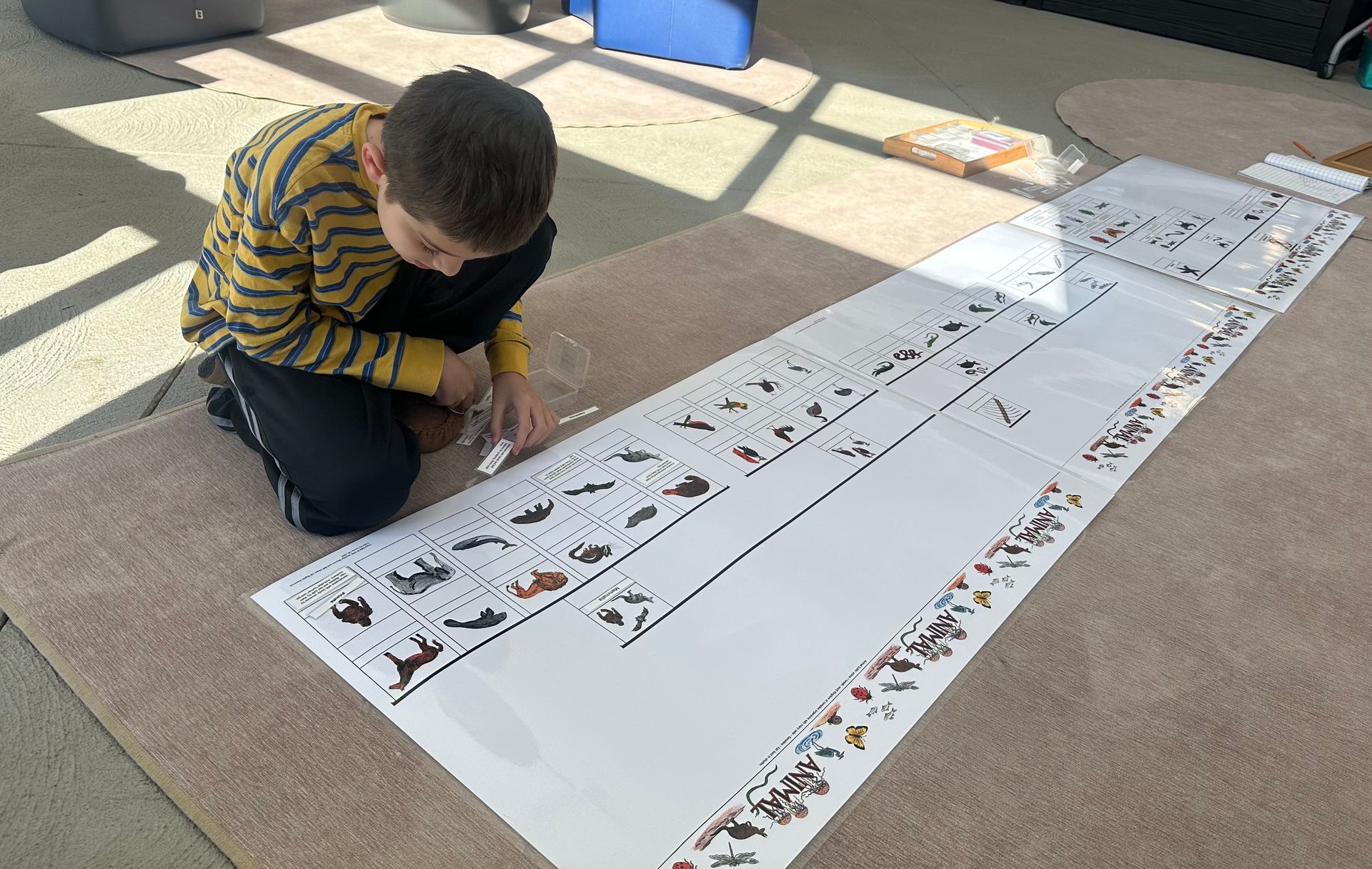
Focusing on biology and zoology, this lesson uses the colorful Timeline of Life to show the unfolding of living organisms from early single-celled life through ancient seas, dinosaurs, and mammals. It naturally inspires deep research into plant and animal classification, adaptation, and ecology.
3. The Coming of Human Beings
Children explore the arrival of early humans and the unique gifts that set us apart: an imaginative mind, capability for love and community, and hands that can fashion tools. This lesson builds gratitude for human ancestors and serves as an entry point into history, archaeology, and human geography.
4. The History of Writing
From ancient cave paintings and cuneiform to hieroglyphs and modern alphabets, children discover how humans invented written language to pass thoughts across space and time. Learning this story while mastering their own writing inspires a deep respect for literacy.
5. The History of Mathematics
Children trace how early societies developed counting systems, measurement, and geometry to solve real-world challenges like farming, building, and trade. Understanding that math is a universal human invention makes learning abstract concepts purposeful and exciting.
Preparing Children for Life
When children understand how nature and human history interconnect, they naturally develop gratitude, environmental stewardship, and a sense of responsibility to their community. Cosmic Education doesn't just deliver academic knowledge; it helps construct thoughtful, compassionate individuals who feel connected to the world around them.
Seeing Cosmic Education in action is the best way to understand its magic! We invite you to
schedule a visit to Wading River to tour our Elementary classrooms and see how we inspire a lifelong love of learning.