
Awakening the Mathematical Mind: How Children Build Deep Understanding from Concrete to Abstract
Whether we embrace math or not, humans have a natural inclination to think in patterns, quantify, and make logical connections. Dr. Maria Montessori observed that young children possess an innate "mathematical mind"—an intuitive drive to estimate, order, calculate, and categorize the world around them.
In our Primary classrooms (3 to 6 years), we honor this inclination by offering carefully sequenced learning experiences that build a deep, logical foundation for math long before children ever pencil down traditional formulas.
Organized into six general groups, the mathematical progression in our Primary program spans from a foundational understanding of the numbers 1 to 10, to working with large numbers in the decimal system, internalizing math facts, and even exploring early fractions!
1. Numbers 1 to 10
Learning numbers 1 through 10 involves integrating several distinct mathematical concepts. Montessori materials isolate each concept step-by-step so a child’s understanding grows with total clarity. This first sequence teaches names, symbols, quantities, and sequence.
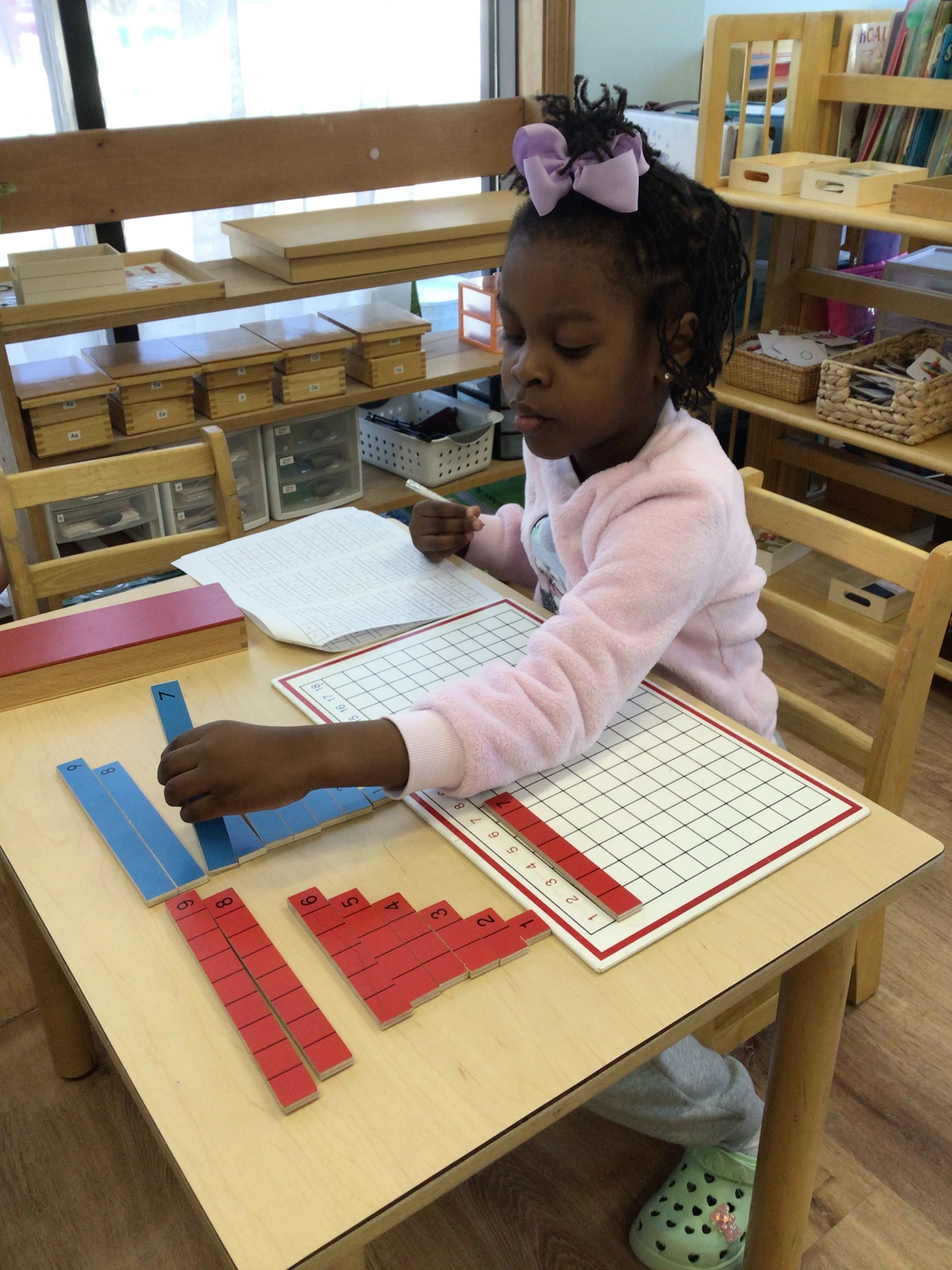
- Number Rods: Color-coded with alternating red and blue sections, these rods help children solidify the concept of quantity as a single entity while practicing one-to-one correspondence.
- Sandpaper Numbers: Children trace numerals with their fingertips, connecting the tactile feeling of the symbol with its name.
- Connecting Quantity and Symbol: Materials like the Spindle Boxes, Cards and Counters, and Memory Games guide children from viewing quantity as a single rod to understanding how quantities form sets.
Throughout this progression, children engage in experiential activities that offer a sensorial impression of addition, subtraction, multiplication, and division before formal operational vocabulary is introduced.
2. The Decimal System
Once a child masters 1 through 10, they are introduced to the Golden Bead Material. Because there are never more than nine in a given place value, and children already understand 1 to 10, they are naturally ready to explore units, tens, hundreds, and thousands.
Children set up "bead banks" and physically handle single unit beads, ten-bars, hundred squares, and heavy thousand cubes. They gain a visual and muscular memory of place value hierarchy.
Working with the golden beads allows children to perform four-digit addition, subtraction, multiplication, and division. Our focus is on helping the child understand the process of each operation—what it physically means to combine, take away, or distribute quantities—rather than just finding a correct answer on paper. Later, materials like the Stamp Game and Dot Game bridge this work toward symbolic representation.
3. Continuation of Counting
In this group of exercises, children learn the names, symbols, and quantities for numbers from 11 to 100, and consolidate linear counting up to 1,000.
- Teen & Ten Boards: Help children understand how numbers are constructed (e.g., 10 and 1 make 11).
- Colored Bead Stair: Sensorially reinforces quantities 1 through 10 using vibrant, consistent color coding.
- Bead Chains: Children unfold long cabinet bead chains across the classroom floor, physically seeing the dramatic linear difference between 100 (10 squared) and 1,000 (10 cubed). Unfolding these chains also provides foundational practice in skip-counting, laying the groundwork for multiplication.
4. Exploration and Memorization of Math Facts
Through dedicated materials—including the Addition Strip Board, Addition Snake Game, Subtraction Strip Board, Subtraction Snake Game, Multiplication Bead Board, Bead Bars, and Unit Division Board—children gain hands-on practice with basic math facts.
This visual exploration creates a clear picture of what a problem like 56 actually looks like, establishing early neural pathways for recall. Through repetition, children naturally internalize these facts, discovering that mental calculation is eventually faster than setting up the physical materials!
5. The Passage to Abstraction
As children reach the end of their Primary years, they naturally seek efficiency. In the passage to abstraction, learning shifts from experiential understanding to logical deduction:
- Small Bead Frame: Revisits addition and subtraction on an abacus-style frame.
- Wooden Hierarchy Material: Sensorially introduces large quantities up to one million.
- Racks & Tubes (Division Test Tube Material): Allows children to calculate long division with large divisors and dividends.
6. Sensorial Fractions
The final sequence in our Primary math progression introduces fractions. Children begin by exploring metal fraction inset apples and circles sensorially. They physically see how a whole divides into halves, thirds, fourths, and so on. As they grow ready, they explore simple fraction operations and equivalence (discovering that two fourths equal one half) with their hands.
Seeing the Mathematical Mind in Action
In our classrooms, math is never forced memorization or dry worksheet repetition. By honoring the concrete-to-abstract journey, children build true mathematical confidence, logical reasoning, and a joyful appreciation for numbers that lasts a lifetime.
We invite you to experience our prepared environments firsthand! Contact us to
schedule a tour and see our students' mathematical minds in action.